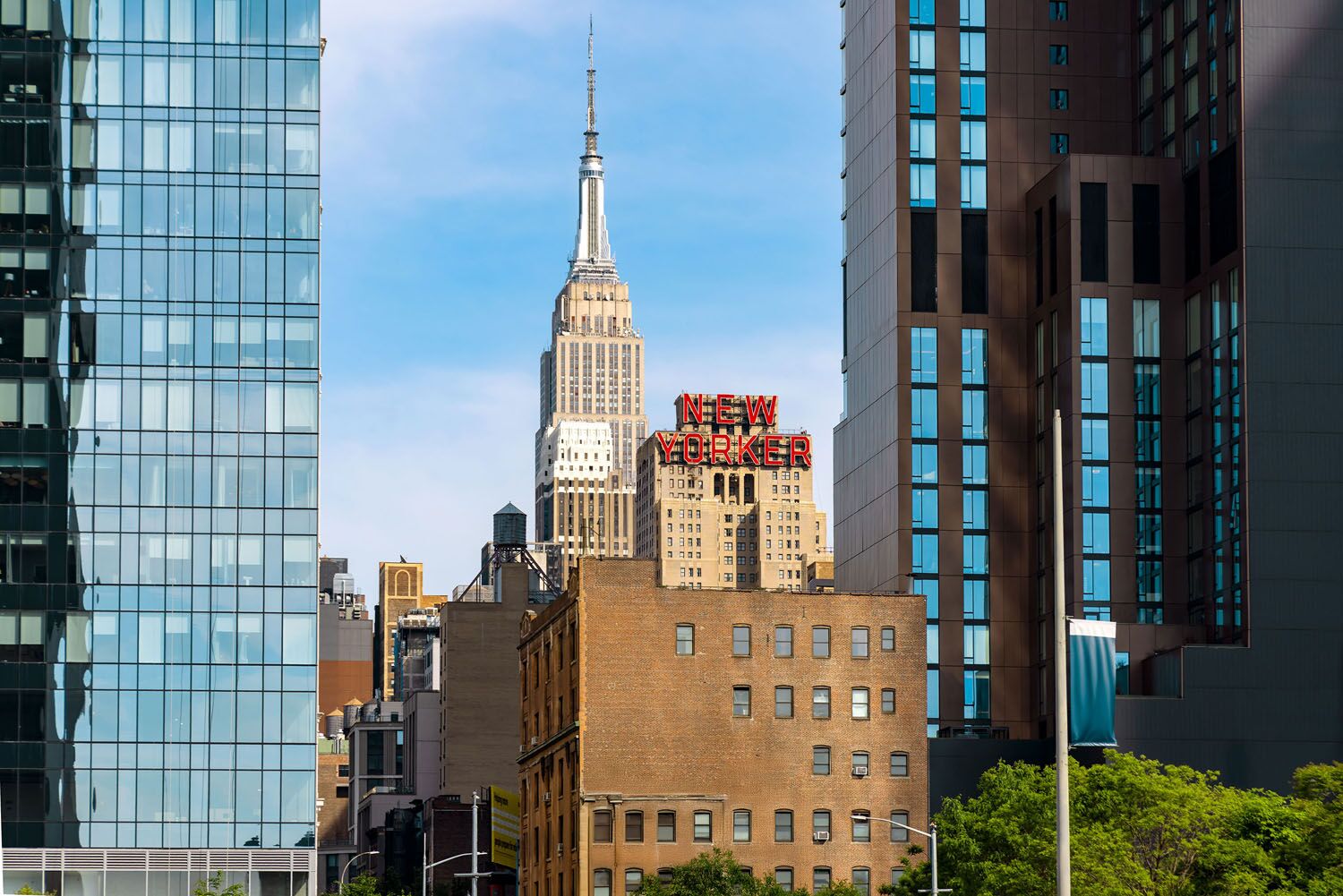
Few cities in the world are defined by their skyline the way New York is. And few buildings contribute to that skyline with as much character and history as The New Yorker Hotel.
Among historic New York hotels, The New Yorker stands apart, not simply because of its age, but because of what it represents. Opened in 1930 at the height of the Art Deco movement, it rose during one of Manhattan’s most ambitious architectural eras. It has witnessed economic upheaval, cultural revolutions, golden ages of entertainment, and the constant reinvention of Midtown itself.
To understand the history of The New Yorker Hotel is to understand a chapter of New York’s own story.
The Rise of an Art Deco Icon (1930)
When The New Yorker Hotel opened in 1930, it was one of the largest hotels in New York City, boasting more than 2,500 rooms and cutting-edge infrastructure for its time.
Built during the height of the Art Deco era, its clean vertical lines, geometric ornamentation, and commanding presence on 34th Street reflected the optimism and ambition of early 20th-century Manhattan. At a time when New York was racing skyward, with the Empire State Building rising just blocks away, The New Yorker became part of the city’s architectural ascent.
The hotel originally featured more than 2,500 rooms, private power generation, and advanced infrastructure that positioned it as a marvel of modern engineering. It wasn’t simply a place to stay; it was a symbol of progress.
Within the landscape of historic hotels in NYC, few properties were conceived on such a grand scale and fewer still remain standing today.
A Storied Legacy: Culture, Innovation & Guests Through the Decades

From the moment it opened on January 2, 1930, The New Yorker Hotel was more than just a place to stay it became a vibrant part of Manhattan’s cultural fabric.
- Cultural programming and entertainment: Throughout the 1930s and 1940s, The New Yorker was a hub for musical innovation. Live radio broadcasts, especially big band performances by acts like Benny Goodman and Tommy and Jimmy Dorsey, emanated from the hotel’s famed Terrace Room.
- World events and sporting history: In the early 1940s, when the Brooklyn Dodgers faced the New York Yankees in the first Subway Series, the team made The New Yorker its home base – a testament to its prominence in city life.
- Nikola Tesla’s final chapter: One of the most remarkable chapters in the hotel’s history began in 1933, when Nikola Tesla moved into rooms 3327 and 3328, living there for the last decade of his life until his death in 1943. Tesla held annual press gatherings on his birthdays and remains one of the most famous figures associated with the property.
- Technological firsts: In 1948, The New Yorker became one of the first hotels in the world to install television sets in guest rooms, advertising itself as having more TVs under one roof than any other hotel at the time – a nod to its commitment to forward thinking.
For decades, the hotel moved with the rhythms of a changing city, entertaining soldiers before deployment during World War II, hosting athletes recuperating from historic games, and welcoming guests who themselves shaped history.
Reinvention & Rebirth: From Closure to Modern Era
Like many historic New York hotels, The New Yorker faced challenges in the mid-20th century as travel patterns shifted and the hospitality industry evolved.
- 1972 Closure: After decades as a social and cultural anchor in Midtown Manhattan, the hotel closed its doors amid economic pressures and operational struggles.
- Unification Church Ownership (1976–1980): The building found new purpose when acquired by the Unification Church, which envisioned a mission headquarters and undertook substantial renovation work.
- 1994 Reopening: After more than two decades without guests, The New Yorker reopened as a hotel once again under NEWYORKER Hotel Management Company. Initially modest in scale, with fewer than its former thousands of rooms, this relaunch marked a new chapter of hospitality on Eighth Avenue.
- 2001 Tribute & Service: In the wake of the 9/11 attacks, the hotel demonstrated civic leadership by offering 10,000 free nights to first responders and volunteers, cementing its role not just as a landmark, but as a participant in the life of the city.
- 2006 Renovation: A multi-year restoration began to preserve the hotel’s historic Art Deco features while updating infrastructure to modern standards – connecting past grandeur with present comfort.
- 2014 Evolution: The property joined the Wyndham Hotels & Resorts family, marrying timeless design with contemporary hospitality. Expansion, updated décor, and added executive rooms helped reestablish the hotel in the 21st-century travel landscape.
- 2025 New Era: The New Yorker joined Lotte Hotels: ushering in ambitious global stewardship and signaling yet another chapter in its continuing evolution as a historic Manhattan icon.
A Historic Landmark, Reimagined for Modern Midtown
Historic New York hotels endure because they evolve. While The New Yorker’s façade and legacy remain rooted in 1930s Manhattan, the experience inside continues to adapt to the needs of today’s traveler.
Staying here isn’t simply about proximity to Midtown, it’s about inhabiting a building that has hosted nearly a century of stories, now thoughtfully updated for a new era.
Accommodations with Architectural Character

Guest rooms blend modern comfort with subtle nods to the hotel’s Art Deco heritage. Clean lines, city views, and updated furnishings create a stay that feels contemporary, while the building’s historic bones remain unmistakable.
From standard guestrooms to Executive Rooms and Suites overlooking the Manhattan skyline, accommodations reflect the scale and ambition that defined the hotel from its earliest days.
Dining Within a Manhattan Icon
Dining has long been central to the hotel’s identity. In its early decades, live orchestras performed in its grand spaces. Today, culinary experiences continue that tradition of gathering and atmosphere.
- Tick Tock Diner
A Midtown staple serving classic American fare from morning through late night – echoing the round-the-clock energy that has always defined this part of Manhattan. - Butcher & Banker
Set inside a former bank vault beneath the hotel, this atmospheric steakhouse feels both historic and distinctly modern – a reminder that reinvention can enhance legacy. - Trattoria Bianca
Offering traditional Italian cuisine in a warm, welcoming setting, Trattoria Bianca reflects the international spirit that has always flowed through Midtown.
Rather than replacing history, these spaces extend it – keeping the building active, social, and alive.
Meetings, Events & Continuing the Tradition of Gathering
Since its opening, The New Yorker has hosted musicians, athletes, innovators, and dignitaries. That tradition continues through its meeting rooms and event venues in Midtown Manhattan.
Ballrooms and flexible event spaces accommodate conferences, weddings, and corporate gatherings, a modern reflection of the hotel’s long-standing role as a center for assembly in Manhattan.
Where big band broadcasts once echoed, presentations and celebrations now take place – different eras, same spirit of gathering.
Among the Most Historic Hotels in New York City
New York is constantly changing. Buildings rise, neighborhoods evolve, and the skyline never stands still.
Since 1930, The New Yorker has been part of that movement.
Its Art Deco façade remains a defining feature of Midtown Manhattan, and its history is woven into the story of the city itself. From cultural milestones to architectural significance, it stands among the most historic hotels in New York – not as a relic of the past, but as an active part of the present.
Guests don’t stay here for nostalgia alone. They stay for the location, the character, and the experience of being inside a building that has witnessed nearly a century of Manhattan life.
If you’re looking for a historic hotel in NYC that places you in the center of Midtown – with the energy of the city just outside your door, The New Yorker offers exactly that.